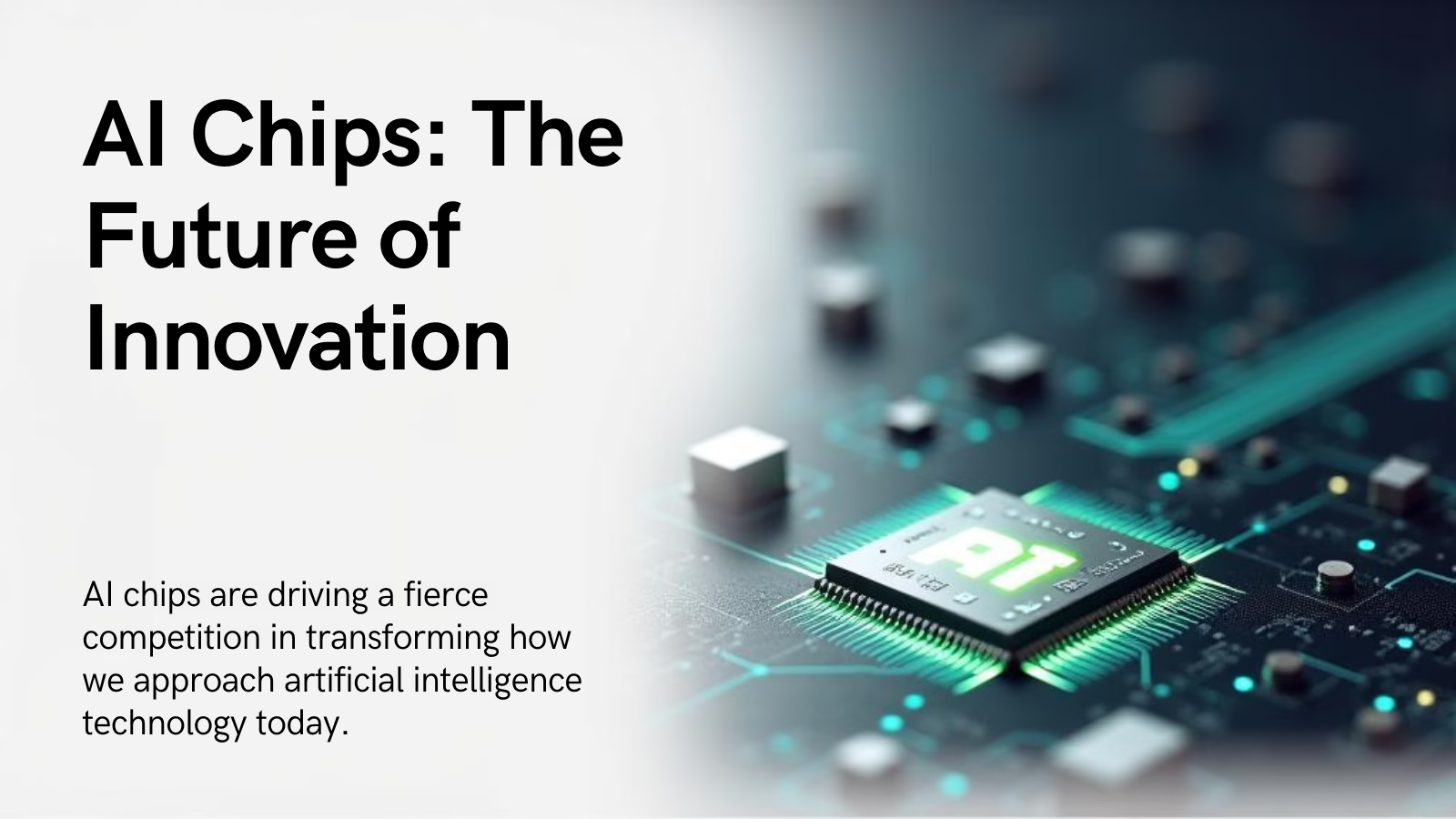
When Sam Altman, CEO of OpenAI, told an audience earlier this year that “the future of AI is gated by compute, not ideas,” he was speaking to an uncomfortable truth. Software innovation is racing ahead, but the real bottleneck lies in AI chips and custom hardware the silicon engines that make massive models possible.
From Silicon Valley labs to Bengaluru co-working spaces, developers echo the same frustration: training a large language model takes too long and costs too much. The solution? Specialized hardware built for one purpose supercharging AI.
Why Traditional Processors Can’t Keep Up
For decades, central processing units (CPUs) were the backbone of computing. Then came graphics processing units (GPUs), originally designed for gaming, which revolutionized deep learning by offering parallel processing at scale. NVIDIA’s GPUs, in particular, became the fuel for the AI boom.
But as models like GPT-4, Gemini, and Claude demand trillions of calculations per second, GPUs are straining under the weight. The costs are staggering: training a frontier model can run into tens of millions of dollars. Energy consumption is another pain point—running a single large-scale training cycle consumes as much electricity as powering thousands of homes.
This is where custom AI chips enter the story. Unlike general-purpose processors, they’re built for highly specific workloads whether that’s computer vision, natural language processing, or edge AI. For businesses, this isn’t just an engineering problem—it’s a question of survival.
The Startups Betting Big on AI Hardware
Venture capitalists love software’s scalability. But in 2025, many are betting that hardware is the new frontier. A wave of startups is rethinking what a chip should look like in an AI-first world.
- Cerebras Systems has built the world’s largest computer chip, the Wafer-Scale Engine, which looks more like a tablet than a processor. It’s designed to shrink training cycles from months to days, and companies like GlaxoSmithKline are already using it for drug discovery (Wired).
- Graphcore, a U.K.-based startup, is pushing its Intelligence Processing Units (IPUs) as more efficient alternatives to GPUs for specific deep learning workloads.
- Tenstorrent, led by chip legend Jim Keller, is designing hardware for edge AI, targeting everything from autonomous vehicles to robotics.
In India, startups are approaching the challenge differently: designing low-cost, energy-efficient accelerators for sectors like healthcare and agriculture, where access to cloud GPUs is limited. According to founders at Bengaluru’s Nasscom AI Conclave, “local conditions demand local innovation.”
Why Big Tech Is Building Its Own Chips
It’s not just scrappy startups. Big Tech has realized that controlling the hardware layer is critical for controlling costs, scaling AI, and building defensible moats.
- Google’s Tensor Processing Units (TPUs) are now on their fifth generation, powering both internal services like Google Photos and external tools like Gemini AI.
- Amazon Web Services has rolled out Inferentia and Trainium chips, claiming they cut training costs by 40% compared to NVIDIA hardware.
- Apple integrates its Neural Engine into every iPhone, quietly running on-device AI features like FaceID and predictive text.
- Tesla’s Dojo supercomputer, powered by its own custom chips, is training self-driving AI faster than traditional GPU clusters (TechCrunch).
By building custom hardware, these companies are reducing reliance on NVIDIA, whose GPUs remain scarce and expensive. In the words of one AWS executive: “The future of AI economics will be won or lost on silicon.”
Human Impact: What Custom AI Chips Mean for Developers and Businesses
Behind the billion-dollar headlines are human stories. On Reddit, a Bengaluru machine learning engineer shared how migrating from GPUs to TPUs cut his training bill by nearly half—and shaved days off his deadlines. For a startup, that can mean launching a product months earlier.
The ripple effects extend across industries:
- Healthcare: Faster image recognition can speed up cancer diagnostics.
- Finance: Fraud detection can happen in real-time with lower latency chips.
- Retail: Smaller players can afford recommendation engines that were once exclusive to giants like Amazon.
In short, custom hardware is democratizing AI, allowing more businesses to access advanced capabilities without breaking the bank.
Geopolitics: The Semiconductor Arms Race
The race for AI hardware isn’t confined to boardrooms—it’s shaping global geopolitics.
The U.S. has restricted exports of advanced AI chips to China, escalating a semiconductor cold war. In response, China is doubling down on domestic chipmaking efforts, while India has announced a multibillion-dollar push under its Semicon India program (Economic Times).
“Hardware is the new oil,” remarked one Delhi-based venture capitalist. “Whoever controls it will control the future of AI.”
What’s Next for AI Chips?
Looking ahead, three trends stand out:
- Energy-Efficient Chips: As sustainability concerns grow, expect more hardware designed to cut AI’s carbon footprint.
- Neuromorphic Computing: Chips modeled after the human brain could deliver breakthroughs in speed and efficiency.
- Quantum AI Hardware: Still experimental, but if successful, quantum processors could make today’s AI training look primitive.
For investors, the message is clear: the AI chip market isn’t just another trend—it’s a foundational shift.
Conclusion: The Muscle Behind the Mind
AI may be defined by software innovations, but its true foundation lies in silicon. Without AI chips and custom hardware, the next wave of intelligent applications simply won’t scale.
From a San Francisco engineer debugging models at midnight, to a healthcare startup in Delhi diagnosing patients faster, the story is the same: AI’s future will be decided not just by code, but by the chips that power it.
The question for 2025 isn’t whether AI chips matter it’s who will own the race to build them.
Thank you for your sharing. I am worried that I lack creative ideas. It is your article that makes me full of hope. Thank you. But, I have a question, can you help me? https://accounts.binance.info/ar-BH/register-person?ref=S5H7X3LP